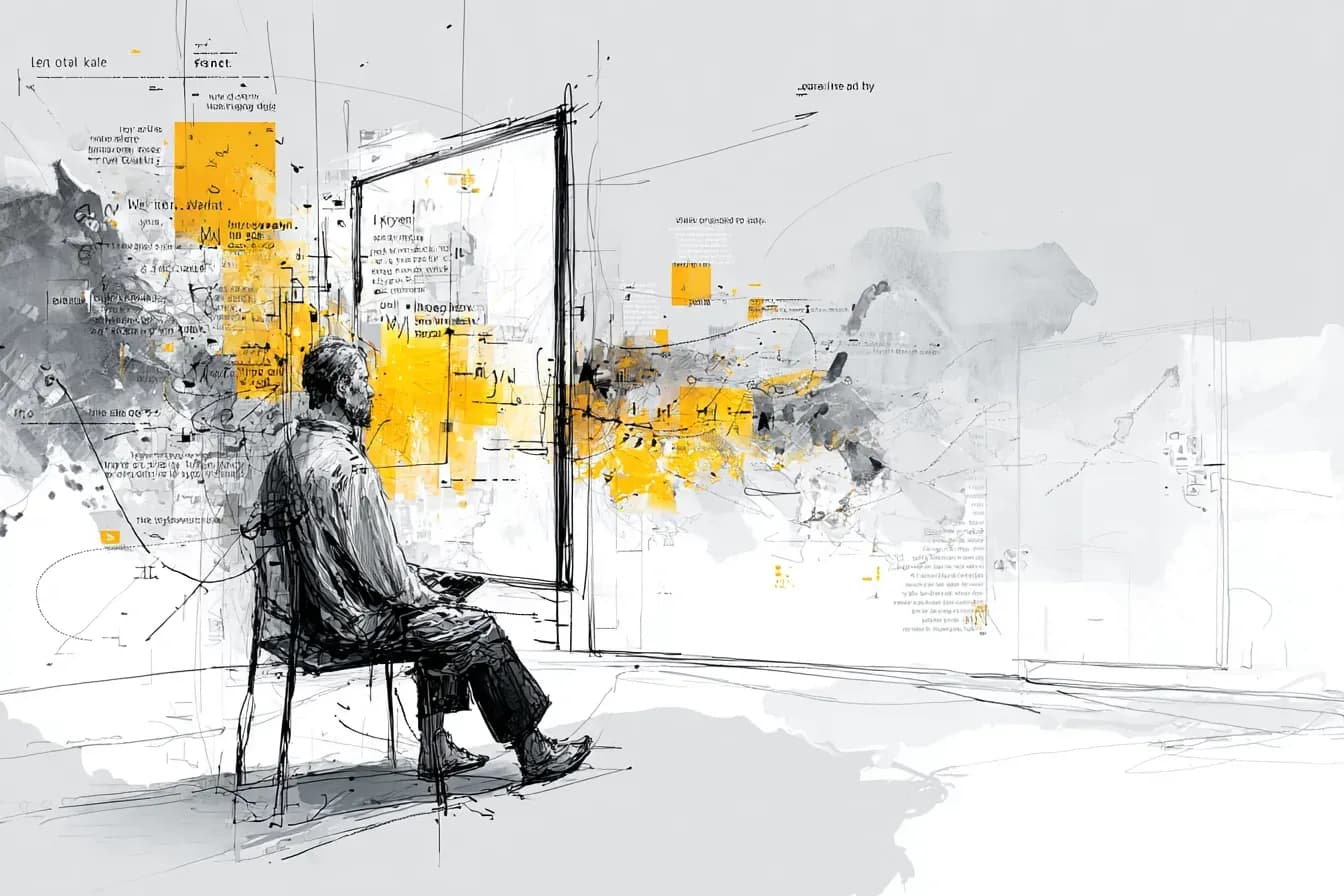
We are all now fairly aware that our social feed is not neutral. We know that what we see is the result of algorithmic choices, optimised to maximise attention, engagement and time spent (i.e., the profit metrics of advertising). But have we ever wondered whether the same mechanism applies to our conversations with artificial intelligences? And above all, whether those dialogues are not becoming ever more a reflection of our own thoughts, our biases, and the logic of the algorithm responding to us?
Echo chambers are not disappearing, they are merely changing shape and location.
For years we have described echo chambers (or filter bubbles in the context of social networks, following Pariser) as a side effect of social media. Closed informational environments where similar opinions mutually reinforce one another and dissent is progressively excluded. Research has shown that these dynamics are not generated solely by algorithms, but are rooted in deeply human mechanisms: confirmation bias, the need for belonging, the search for identity coherence. Algorithms do not create these traits, they amplify them. The empirical evidence is however complex: some studies suggest that artificially breaking information bubbles does not automatically reduce polarisation, a sign that cultural fractures precede technology; others show, however, that when echo chambers exist they tend to sharpen affective polarisation, to rigidify identities, and to make people more resistant to factual corrections. In particular, closed communities favour the spread of distorted narratives that become, for those immersed in them, the “normal” version of reality.
So far, nothing new. The discontinuity emerges when we shift our gaze from dialogue between people — mediated by platforms — to the direct dialogue between a person and their generative agent, whatever ChatGPT-like tool they use. Here the echo changes scale and nature. It is no longer social, it is individual. The agent does not expose us to a like-minded group (we no longer risk “falling into the pond”), but returns to us a refined, coherent and often reassuring version of our own thinking, in a metaphorical mirror. It learns our language, recognises our patterns and, above all, knows how to speak to us. Generative models are not only informational tools, but also rhetorical tools. Numerous studies show that conversational AIs are already today capable of producing persuasive texts comparable to those produced by humans, and in some cases more effective. Their strength lies not only in the correctness of their answers, but in the ability to adapt tone, structure and argumentation to the profile of the interlocutor.
When this capability is embedded in a stable and personalised relationship, the risk is not so much explicit disinformation, as systematic confirmation (which becomes bias). This gives rise to what some researchers call chat-chambers: conversational micro-echo chambers in which the user tends to trust the AI’s responses above all when they reinforce pre-existing convictions. External verification becomes superfluous, because the dialogue appears fluid, empathetic, coherent. The AI assumes the role of primary epistemic source, often more authoritative than real people, because it is always available, patient, “rational”. In this context, radicalisation changes form: it no longer passes through ideological conflict or exposure to extreme content, but through a slow cognitive drift. There is no need to openly persuade — just not to contradict. Just accompany the user along an ever more coherent trajectory, ever less porous to doubt. It is a frictionless radicalisation, invisible, because it is experienced as a natural evolution of one’s own thinking.
The issue becomes even more delicate if we read it through the lens of Byung-Chul Han. Han observes how the loss of grand narratives in contemporary society (and in particular, on the right, due to a symbolic necessity and a structural need for strong myths and stories) is felt more acutely, generating a demand for meaning that seeks answers. Generative agents are enormously powerful narrative machines. They can produce personalised myths, reconstruct symbolic genealogies, give order and coherence to scattered fragments. They can offer reassuring visions without ever truly putting them to the test.
This is where the concept of infocracy gains its full meaning. We are no longer just in a filtered reality, but in a potentially mystified one: information is not censored, it is modelled. It is not denied, it is made plausible. Infocracy does not govern against freedom, but through it. If before we lived in a reality transformed by the media, today we risk inhabiting a synthetic reality that precedes us. A reality that arrives already interpreted, explained, pacified. A cognitive environment that reduces friction, eliminates ambiguity and protects us from internal conflict.
For my generation it is inevitable to recognise here the metaphor of the Matrix, which ceases to be merely evocative. With the difference that it is not a single centralised simulation, but millions of individual cocoons, each with its own coherent version of the world, guarded by AI. A reality mediated by AI is now difficult to avoid; we must therefore hypothesise that the safeguarding of critical judgement passes through the ability to design agents capable not only of understanding us, but of contradicting us. Agents capable of introducing friction, dissonance, uncomfortable questions. Today freedom of thought passes no longer through access to information, but through the ability to tolerate and sustain doubt. Choosing the red pill, perhaps, will not mean switching off the machines, but teaching the machines — and ourselves — the art of contradiction in dialogue.