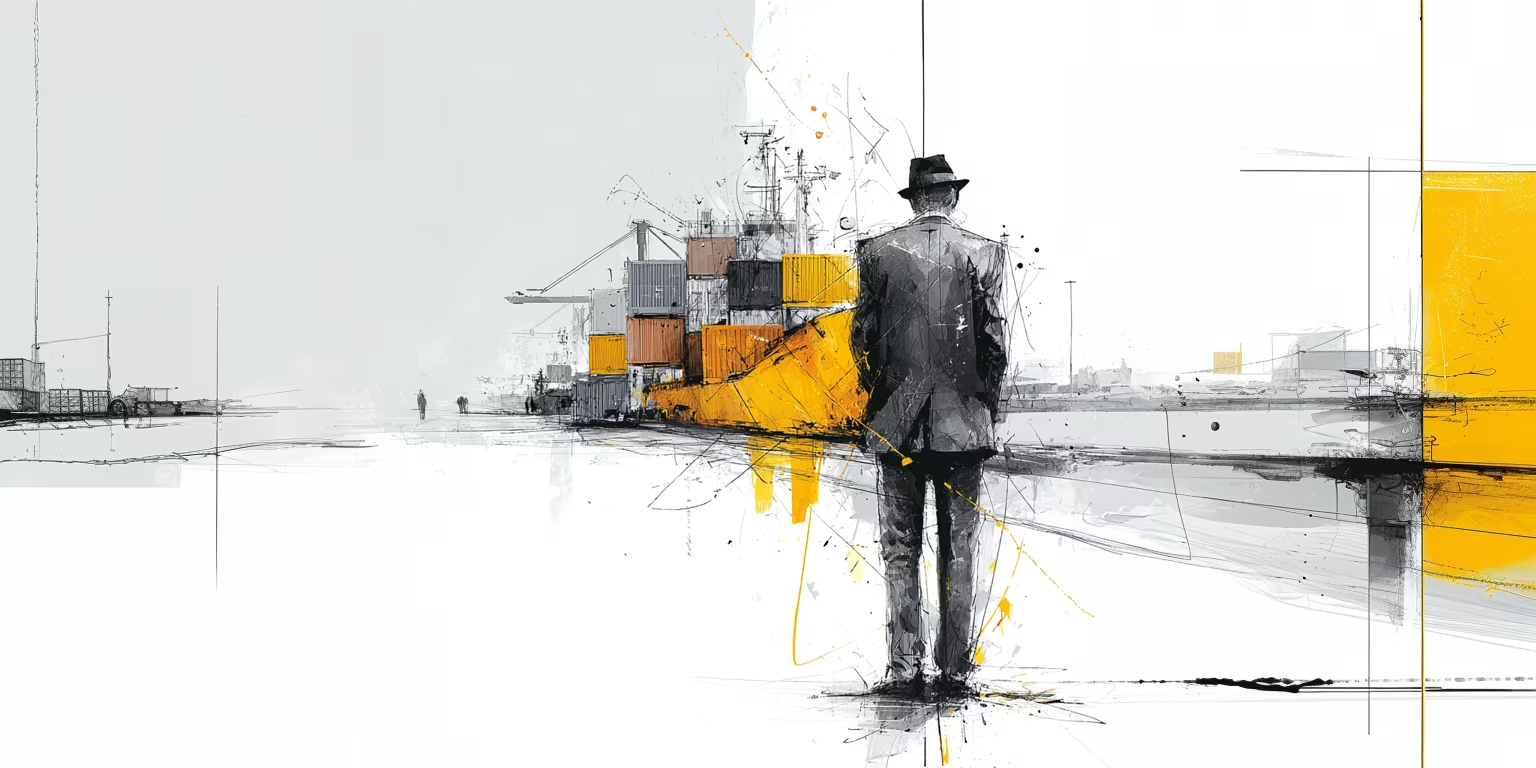
Newark, 26 April 1956. That afternoon, a truck driver from North Carolina loaded 58 metal boxes onto an old Second World War tanker, the Ideal-X. His name was Malcolm McLean. On the quay, invited to watch, were the executives of the big American shipping companies. McLean was not one of them. He was a truck driver. The year before, he had sold his trucking company - his life's work - to fund an idea about an industry in which he had never worked a single day. Twenty years earlier, in 1937, he had been sitting on the running board of his truck at the port of Newark, waiting to unload bales of cotton that had come in from Fayetteville. He had been waiting for hours. In front of him, dockworkers moved bale after bale, one at a time, from the trailer to the ship. Slow. Expensive. Absurd.
There, on the running board, he asked himself a question: why can't I load the whole trailer onto the ship? The shipping companies, on that 26 April 1956, asked themselves the wrong question. They asked: why would anyone want to ship empty metal boxes instead of loose cargo? It was an intelligent question, from their point of view. It was also the one that, ten years later, would wipe them out. For twelve years the container remained a niche. Then in 1968 came the ISO standard. Over the following twenty years, port productivity increased by 10,000%. Modern globalisation was born there - from a truck driver who, twenty years earlier, had asked himself a question on the running board of a truck.
Italian companies are asking themselves the same wrong question
Over recent months, with the FAIRFLAI team, we produced Illumina: the first Italian research study on AI adoption in companies. 83 companies, 17 structured questions, 14 qualitative interviews. Entirely Italian, because we had grown tired of reading American data and pretending it was ours too. Four findings above all.
- 65% / 23%. There is too little investment in people. 65% of Italian companies have invested less than 4 hours of AI training per person over the past two years. 23% still don't know whether they will invest in 2026. We are talking about the technology that will redefine what it means to work, and we can't find the time to teach people how to use it.
- 83% / 17%. Individual AI use has grown. Company-wide use has not. In the Italian companies where AI has already made its way in, 83% of usage is individual: fragmented, uncoordinated across teams. Only 17% is collective. The individual has augmented themselves. The company has not.
- 23% / 41% / 5%. Few projects, and isolated ones. 23% of companies have not launched a single pilot. 41% have launched between one and three. Only 5% have more than seven running in parallel. Few pilots, often disconnected, no economies of scale in learning.
- The 5 reasons pilots fail. No strategy, inadequate data, missing skills, difficult integration, insufficient resources. None of them is about technology. They are all structural organisational limits.
And when we ran the cluster analysis on the sample, a dominant archetype emerged: 52% of Italian companies fall into a cluster we called "curious but stuck". High interest, experiments under way, individual use, shadow risk at the highest level in the sample. The potential is there. The transformation is not. This is the snapshot. POCs that work beautifully taken one by one, and that put all together don't move the P&L by a millimetre. The question is why.
1937: why do firms exist?
To answer that, we need to go back. In the same year that McLean asked himself his question on the running board of his truck, in London an economist named Ronald Coase published a paper that twenty years later would earn him a Nobel Prize. Coase's question is simple: why do firms exist? Why don't we all live as freelancers coordinating through the market? His answer rested on two reasons.
- The first: transaction costs. Building complex products requires orchestrating heterogeneous, complementary skills - chassis, engine, bodywork. Coordinating five separate specialists through the market costs so much that it becomes cheaper to put them all under the same roof. The firm exists in order to internalise those costs.
- The second: the economics of knowledge. The department - Marketing, Finance, Legal, Engineering - is the purchasing unit for specialist knowledge. The firm exists because knowledge was scarce and expensive, and it is on this assumption that it is paid.
For 89 years this answer has held. Now two distinct forces are eroding it at the same time.
- Augmentation. A person augmented by AI spans five skill sets instead of one. The value chain compresses into the single individual. If everyone is doing different things, it no longer makes sense to aggregate homogeneous specialists inside a department. Coase's first reason falls away.
- Automation. Specialist expertise can be executed on demand, at a marginal cost close to zero. The price of labour stops being the price of scarce knowledge. Coase's second reason falls away.
Coordination costs less. Specialisation is no longer a barrier to entry. Coase's question, after 89 years, is open again. And when a question like that reopens, something dies.
The department is dead
Marketing, Finance, Legal and Engineering came into being as organisational units because knowledge was scarce. Now that knowledge is no longer scarce, their reason for existing is gone. AI isn't killing them. It's signing their death certificate.
Sangeet Choudary, in a book published this year called *Reshuffle*, puts it better than we can. He opens the book with the container story itself. His thesis: the container revolution wasn't in the box, it was in the coordination that the box imposed on the world. AI is doing exactly the same thing to the knowledge economy. It isn't a smarter brain - it's better glue.
It reduces the coordination tax, that exponential cost of keeping decisions, people and systems aligned, which was precisely the reason departments existed. But the container, seventy years ago, didn't destroy trade. It reorganised it. Companies were born that couldn't have existed before, because the specialisation barrier had fallen. AI is doing the same thing to knowledge.
Self-management is AI's natural home. Not because someone decided so on paper. Because it is the only structure coherent with a world in which coordination costs almost nothing and specialisation is no longer a barrier. Augmented people crossing role boundaries. Decisions taken where the problem is, not where the title is. Explicit governance, not hierarchical. Holacracy, Rendanheyi, Buurtzorg - AI-native organisations are already there. One clarification, on a narrative that circulates widely and is wrong. AI does not replace professions. It breaks them down into tasks, and recombines those tasks into new flows that cut across the old boundaries. The accountant doesn't disappear. Certain accountant's tasks disappear, and new ones emerge that tomorrow's accountant will perform in combination with other profiles. The same applies to every business function. Work isn't being lost. What's being lost is the unit of measurement around which work was organised.
We're building canals in the age of railways
One of the people interviewed for Illumina said something to us that we haven't been able to get out of our heads: we're building canals in the age of railways. This is exactly the J-curve of adoption. Italian companies layer AI on top of twentieth-century org charts and then wonder why the curve doesn't turn back up. The real upturn doesn't begin when you implement AI. It begins when you stop organising it as an extension of the department.
Illumina is open. Take part. Illumina is open data. It is a continuously open observatory. The more companies take part, the sharper the map of work in Italy becomes. Participants receive as an output their own positioning relative to the clusters we identified - not a generic benchmark, but their own company on the map, among the others.
10 minutes of your time. In return, the only reliable snapshot of where you stand on a trajectory that will redefine your business over the next five years.
PS: There's a footnote to this story that's worth telling. Malcolm McLean - the man who had invented the container in 1956 - tried to do the same thing a second time twenty years later. He bought a new company, United States Lines, bet everything on building twelve enormous super-ships, and asked himself a question: how do I reduce the cost per container? It was an intelligent question. It was also the wrong question. In November 1986, United States Lines filed for bankruptcy. The largest American shipping bankruptcy up to that point. McLean lost everything. The man who had taught the world what it means to ask the right question ended up asking the wrong one.
Asking the right question isn't an event. It's a practice. And it's worth our company, every single time we do it.